
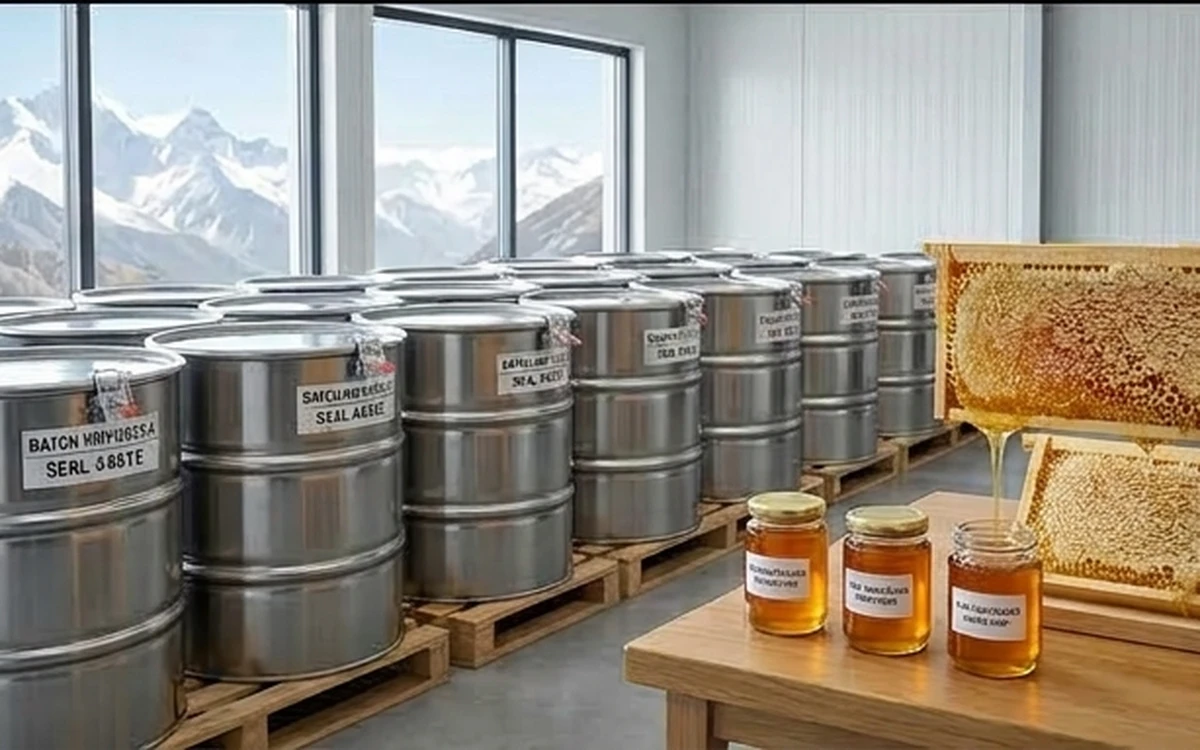
Importing Authentic Himalayan Raw Honey to the GCC: NMR Spectroscopy, C4 Sugar Screening, and GSO 147 Compliance
From high-altitude wild multi-flora apiaries to Nuclear Magnetic Resonance (NMR) spectral profiling at GCC border ports, here is the complete technical import guide for commercial honey buyers in the UAE and Saudi Arabia.

Table of Contents
Bottom Line Up Front (BLUF): Commercial procurement of raw wild Himalayan multi-flora honey and high-altitude forest honey for the Arabian Gulf market requires stringent authenticity verification under Gulf Standard GSO 147/2024 (Honey Specifications). With border inspection laboratories at Dubai (Dubai Municipality Food Safety) and Saudi ports (SFDA) enforcing mandatory Nuclear Magnetic Resonance (NMR) profiling and Stable Carbon Isotope Ratio Mass Spectrometry (EA/LC-IRMS), shipments adulterated with industrial C4 corn syrup, rice syrups, or bio-engineered invert sugars are immediately rejected and blacklisted. Importers must secure certified origin documentation, moisture levels under 17.5%, and diastase activity above 8 Schade units before container loading.
1. The Himalayan Honey Frontier: Market Dynamics in the GCC
The Gulf consumer market possesses the highest per capita consumption of premium raw honey in the world. While native Yemeni and Saudi Sidr honeys command ultra-luxury prices, retail packers, supermarket chains, and private-label distributors in Riyadh, Jeddah, and Dubai seek high-volume, premium raw alternatives with authentic medicinal narratives.
High-altitude Himalayan Multi-Flora and Wild Forest Honey—sourced from the pristine sub-alpine valleys of Himachal Pradesh, Kashmir, and Uttarakhand—fills this critical commercial niche:
- Ecological Purity: Foraged from wild medicinal flora (including Plectranthus rugosus, wild clover, acacia, and rhododendron) in pesticide-free mountain altitudes (1,500m to 3,200m).
- Enzymatic Integrity: Raw, cold-extracted honey that preserves natural invertase, diastase, and bee pollen profiles without high-heat pasteurization.
- Wholesale Scalability: Available in commercial bulk packaging (300kg food-grade epoxy-coated steel drums or 30kg HDPE pails) suitable for commercial bottling plants in the GCC.
Himalayan Apiary / Forest Harvesting (Altitude 2,000m+)
  │
  ├── Cold Settling & Gravity Filtration (Zero High-Heat Treatment)
  │     ▼
  ├── Pre-Shipment Laboratory Fingerprinting (Bruker NMR + LC-IRMS)
  │     ▼
  ├── Food-Grade 300kg ISO Steel Drum Packaging with Tamper-Proof Seals
  │     ▼
  ├── SFDA / GCC Border Customs Clearance (GSO 147/2024 Verification)
  │     ▼
  └── RESULT: Fully Certified Raw Honey Released for GCC Retail Bottling
2. Laboratory Purity Gatekeepers: Testing Protocols Under GSO 147
To protect Gulf consumers from global honey fraud, municipal and food safety authorities subject incoming honey consignments to the world’s most rigorous chemical screens:
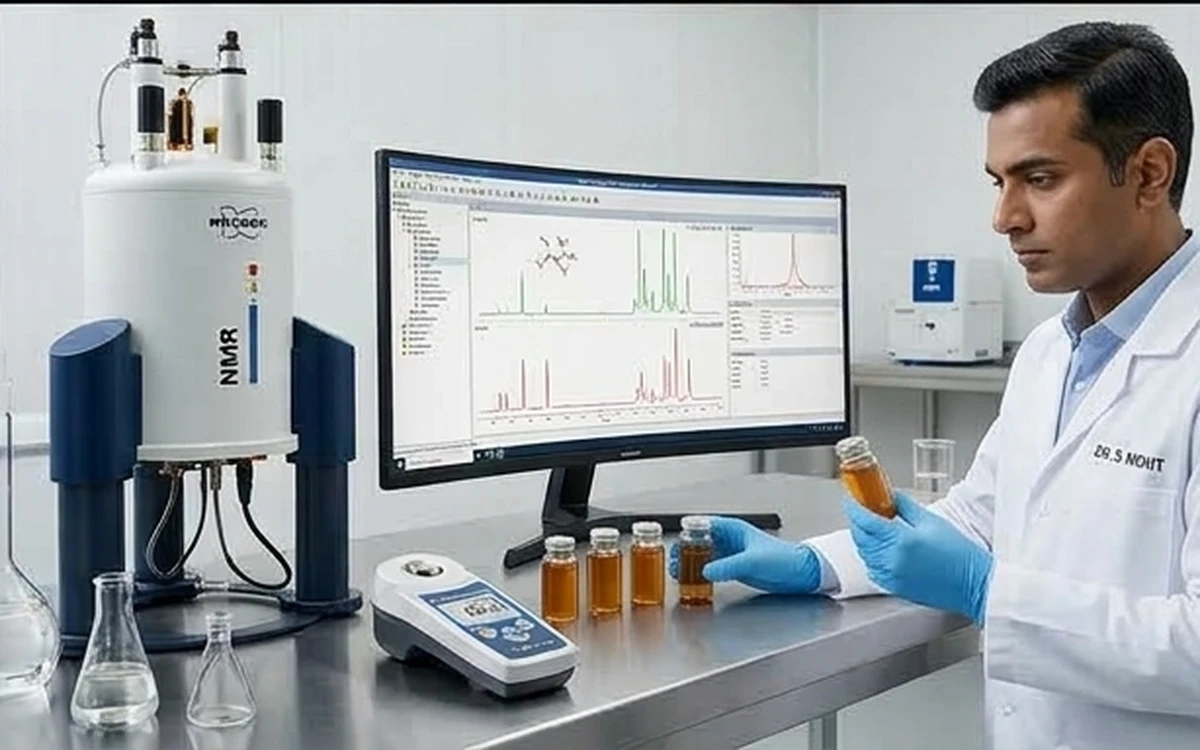 Figure 1: Nuclear Magnetic Resonance (NMR) spectral screening and refractometric moisture analysis for raw Himalayan honey.
| Analytical Parameter | Testing Methodology | GSO 147/2024 Regulatory Limit | Himalayan Raw Honey Standard | Practical Quality Significance |
|---|---|---|---|---|
| Moisture Content | Digital Refractometry | $\le 20.0%$ by weight | $\mathbf{16.5% - 17.5%}$ | Moisture $>18.5%$ risks spontaneous fermentation during sea transit |
| Diastase Activity | Phadebas / Schade Scale | $\ge 8\text{ Schade units}$ | $\mathbf{12 - 22\text{ units}}$ | Confirms honey is raw and unheated; heat degrades enzymes |
| Hydroxymethylfurfural (HMF) | HPLC UV-Vis | $\le 80\text{ mg/kg}$ (tropical zone) | $\mathbf{< 15\text{ mg/kg}}$ | Marker of freshness and absence of excessive heating |
| Fructose / Glucose Ratio | High-Performance Liquid Chromatography (HPLC) | F/G Ratio $\ge 1.0$ | $\mathbf{1.15 - 1.30}$ | Higher fructose prevents premature crystallization in retail jars |
| C4 Sugars (Corn / Cane) | EA-IRMS ($\delta^{13}C$ analysis) | $\le 7.0%$ maximum | $\mathbf{< 1.0%}$ (Negative) | Detects illegal addition of commercial corn syrup or cane sugar |
| Exogenous Rice / Beet Sugar | Oligosaccharide LC-HRMS | Zero Tolerance | Undetected | Uncovers modern bio-engineered syrups that bypass C4 IRMS |
| NMR Profiling | $400\text{ MHz}$ Bruker FoodScreener | Spectrum matching database | Conforming Raw Honey | Validates botanical origin, geographical provenance, and adulteration |
3. The Sugar Syrups Arms Race: Beyond Traditional C4 Testing
Historically, honey testing relied solely on AOAC Method 998.12 (C4 Carbon Isotope Ratio). Adulterators who added corn syrup or cane sugar were instantly flagged because $C_4$ photosynthetic plants have distinct $^{13}C/^{12}C$ isotopic ratios compared to $C_3$ flowering plants visited by honeybees.
However, fraudulent syndicates adapted by synthesizing C3 plant syrups (such as specialized hydrolyzed rice syrup, beet syrup, and wheat syrup), which share the same carbon isotope signature as natural flowers.
The NMR Revolution in Gulf Ports
To counter this, the Saudi Food and Drug Authority (SFDA) and Dubai Central Laboratory (DCL) integrated high-field Nuclear Magnetic Resonance (NMR) spectroscopy:
- Spectral Fingerprinting: The NMR instrument measures hundreds of individual chemical resonances in minutes, comparing the sample’s metabolic profile against a database of thousands of authentic global reference honeys.
- Specific Adulteration Markers: The system scans for synthetic compounds such as 2-acetylfuran-3-glucopyranoside (AFGP) and specific polysaccharide anomalies that prove industrial starch conversion.
- Heat Damage Profiling: NMR instantly detects if honey was artificially cooked to force moisture reduction, invalidating raw marketing claims.
4. Bulk Packaging and Cold-Chain Protection
Unlike processed table honey, raw unpasteurized honey contains living enzymes, active pollen, and wild yeasts. Mishandling during maritime transport can compromise entire container consignments:
- Food-Grade Epoxy-Coated Steel Drums: 300 kg net weight drums coated internally with FDA-approved phenolic food-grade lacquer to eliminate heavy-metal leaching and corrosion.
- Double Tamper-Proof Locking Rings: Heavy-duty lever-lock rings fitted with serialized, barcode-matched security seals recorded on the commercial bill of lading.
- Temperature Discipline During Voyage: Containers traversing the Arabian Sea in peak summer experience ambient hull temperatures exceeding $45^\circ\text{C}$. To prevent exponential HMF buildup (which can surge from 10 mg/kg to over 90 mg/kg under sustained heat, failing GSO limits), commercial buyers utilize thermal liner blankets or refrigerated reefer containers set at $18^\circ\text{C}$ to $22^\circ\text{C}$.
5. Case Study: Resolving a Moisture & Crystallization Dispute
The Scenario
A beverage manufacturer in Dammam contracted four 20-foot container loads (76 metric tonnes) of raw forest honey from northern India. Upon arrival at King Abdulaziz Port:
- The Issue: Port customs sampling flagged two drums with moisture readings of $19.8%$, dangerously close to the $20%$ statutory ceiling, alongside early top-layer granulation (crystallization) in 30% of the drums.
- Root Cause Analysis: Testing revealed the honey was natural raw multi-flora with high glucose concentration. Cold ambient temperatures in mountain packing stations followed by ocean transit triggered natural glucose monohydrate crystallization, which separated minor liquid fructose to the surface, artificially skewing surface refractometer readings.
The Resolution Protocol
- Homogenized Core Re-Sampling: Under SFDA supervision, certified warm-probe core samplers were deployed to draw composite samples through the full depth of the drums.
- Laboratory Verification: Homogenized composite samples yielded an actual moisture content of $17.2%$, fully compliant with GSO 147. Diastase activity measured at a robust $16.4\text{ Schade units}$, and NMR screening confirmed zero exogenous sugar addition.
- Commercial Outcome: The consignment received an official clean release notice within 5 business days, averting an unnecessary multi-thousand-dollar re-export crisis.
6. Strategic FAQs for Commercial Honey Importers
What is the maximum allowable HMF level for honey imported into Saudi Arabia?
Under GSO 147/2024, the standard maximum allowable limit for Hydroxymethylfurfural (HMF) is $80\text{ mg/kg}$ for honey originating from tropical and warm climates (such as the Gulf region and South Asia), compared to $40\text{ mg/kg}$ for temperate European regions. However, premium buyers insist on arrival levels below $20\text{ mg/kg}$ to guarantee multi-year shelf-life stability.
What documents must accompany an international bulk honey shipment?
Every container load requires:
- Original Commercial Invoice and Detailed Packing List with drum serial numbers.
- Clean on Board Bill of Lading.
- Official Government Veterinary / Sanitary Health Certificate issued by the exporting country’s agricultural authority (e.g., EIC in India).
- Third-Party Certificate of Analysis (CoA) from an ISO 17025 accredited laboratory (e.g., Intertek, QSI, or Bruker NMR certified lab).
- Certificate of Origin legalized by the Chamber of Commerce.
- Halal Supervision Certificate (when required for processed honey blends).
How does raw Himalayan honey compare to Sidr honey in wholesale pricing structure?
While mono-floral Sidr honey (harvested from wild Ziziphus spina-christi trees in Yemen and Saudi Arabia) serves as an ultra-luxury table gift, authentic raw Himalayan multi-flora honey offers an exceptional balance of complex herbal tasting notes, enzyme density, and scalable wholesale supply for industrial beverage formulators, cosmetics, and commercial retail packaging.
7. Partner with GB Trading for Verified Bulk Honey
At Global Bridge Trading, we eliminate the risks of the global honey trade through comprehensive analytical verification and direct apiary integration:
-
100% NMR & IRMS Pre-Tested: Every batch is tested prior to departure to ensure zero C3/C4 sugar adulteration and full GSO 147 compliance.
-
Guaranteed Low Moisture: Controlled cold-harvesting maintaining moisture strictly below 17.5% to prevent fermentation in Gulf storage.
-
Secure Industrial Packaging: Supplied in heavy-gauge 300kg ISO food-grade steel drums with tamper-evident serial seals.
-
Review our technical guide on Authenticating Raw Yemeni Sidr Honey
-
Explore our Indian Organic Honey Supply Route to the GCC
-
Learn about Commodity Fraud Prevention Protocols
👉 Contact our Agricultural & Honey Trading Desk on WhatsApp to discuss available crop seasons, laboratory CoAs, and container CFR delivery schedules.