

Importing Indian Organic Honey to the GCC: Navigating APEDA Certification, NMR Testing, and HMF Standards
A rigorous B2B guide for importing bulk organic honey from India to the UAE and Saudi Arabia, focusing on NMR adulteration testing and APEDA compliance.

Table of Contents
Direct Answer: The minimum order quantity (MOQ) for importing bulk organic honey from India to the GCC is typically one 20ft container holding approximately 20,000 kilograms packed in epoxy-lined steel drums. To pass UAE and Saudi customs, the honey must be APEDA certified and undergo Nuclear Magnetic Resonance (NMR) testing to prove zero adulteration from exogenous sugars.
The Middle Eastern market demands premium, pure honey, but the global supply chain is rife with adulteration. For B2B importers in the GCC, sourcing bulk organic honey from India requires stringent verification protocols to ensure the product passes rigorous municipal food safety standards.
The Adulteration Threat and NMR Testing
The most significant risk in wholesale honey procurement is adulteration with cheap C3/C4 sugars (such as rice syrup or high-fructose corn syrup). Traditional testing methods are frequently bypassed by sophisticated adulterants.
To guarantee purity, modern importers mandate Nuclear Magnetic Resonance (NMR) testing. NMR creates a molecular “fingerprint” of the honey, comparing it against a global database to detect even trace amounts of foreign syrups. Any honey intended for high-end retail or organic labeling in the UAE must pass this standard.
APEDA Certification and Traceability
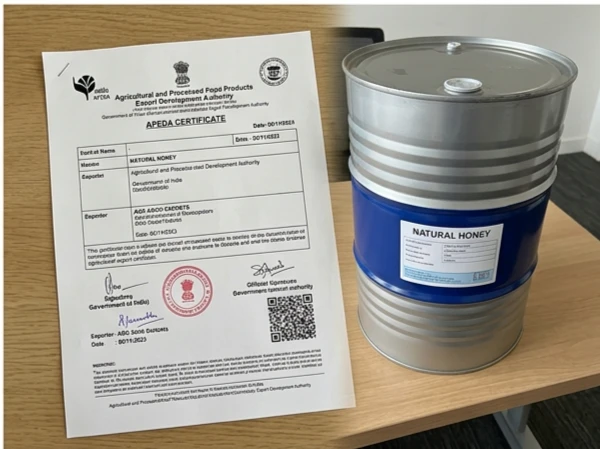
India’s Agricultural and Processed Food Products Export Development Authority (APEDA) oversees the export of organic commodities. Bulk honey exported from India must utilize Tracenet, APEDA’s internet-based electronic service.
This system provides a seamless traceability chain from the individual beekeeper in the Himalayan or central forest regions to the export facility, ensuring the “organic” claim is legally defensible at the destination port.
HMF Levels and Climate Logistics
Hydroxymethylfurfural (HMF) is an organic compound that forms in honey when it is heated or stored for extended periods. GCC regulatory bodies, including Dubai Municipality and the SFDA, strictly monitor HMF levels as an indicator of honey freshness and improper processing.
- Maximum Allowed HMF (Typical): 40 mg/kg (can reach 80 mg/kg for honey originating from tropical climates, pending specific municipal review).
- Logistics Impact: Shipping bulk honey in standard dry containers during the peak of the Gulf summer can cause HMF levels to spike rapidly. Temperature-controlled containers (reefers) are highly recommended for July-September shipments to preserve chemical integrity.
Bulk Packaging: Epoxy-Lined Drums
Wholesale honey is rarely shipped in glass at the import stage due to breakage risks and freight inefficiency. Instead, the industry standard is the 300kg food-grade steel drum. These drums must be lined with food-safe epoxy to prevent the acidic honey from reacting with the steel during transit.
Sourcing with Global Bridge Trading
Global Bridge Trading eliminates the risk of adulteration from your supply chain. We partner exclusively with APEDA-certified Indian apiaries and mandate independent NMR testing prior to container loading, ensuring your bulk honey imports arrive safely and fully compliant with GCC regulations.