
Q4 2026 Indian Basmati Harvest: Managing Moisture, Elongation, and Spot Prices in the GCC
As the 2026 Kharif crop reaches GCC ports, importers face moisture volatility and shifting price spreads. Here is how procurement teams evaluate 1121 vs 1509 Basmati to protect margins and quality.

Table of Contents
Bottom Line Up Front (BLUF): The Q4 2026 Kharif Basmati harvest is arriving across Jebel Ali, Khalifa Port, and King Abdulaziz Port Dammam with market dynamics unconstrained by Minimum Export Prices (MEP). While farm-gate arrivals in Haryana and Punjab show robust yields, fresh-harvest moisture levels are running between 14.5% and 16.0%. Importers must strictly demand parboiled (Sella) or steam-cured specifications with certified moisture below 12.5% to prevent sweating and yellowing in GCC transit. For hospitality caterers, 1509 Steam currently offers a 16% to 19% cost advantage over 1121 without sacrificing the critical 19mm+ cooked elongation threshold.
1. The Post-MEP Landscape: What Q4 2026 Means for GCC Importers
The removal of the Minimum Export Price (MEP) on Indian Basmati rice fundamentally changed the procurement calculations for food distributors, central commissaries, and hypermarket chains across the United Arab Emirates and Saudi Arabia.
During the price-floor regime, exporters were forced to invoice contracts at or above the official benchmark, often creating artificial premiums or off-balance-sheet compensations. In the current open-market environment:
- Market-Driven Price Discovery: Spot prices for genuine 1121 and 1509 Basmati varieties now directly track real farm-gate mandi volumes, paddy arrival velocity, and container freight rates out of Mundra and Kandla ports.
- Quality-Tier Differentiation: Without an artificial price floor, millers can no longer disguise secondary or blended grades under a generic high price tag. Real technical specifications—specifically grain elongation ratio, purity percentage, and moisture retention—now dictate market premiums.
- Paddy Influx Velocity: The Kharif harvest spanning October and November represents the largest supply influx of the agricultural year, providing GCC procurement managers their optimal window to lock in fixed-volume quarterly contracts.
2. 1121 vs. 1509 Basmati: The Technical and Financial Spread
The dominant commercial debate among Middle Eastern procurement directors centers on Pusa Basmati 1121 versus Pusa Basmati 1509. While both cultivars are officially recognized under the APEDA Basmati schedule, their botanical maturity, grain elongation, and commercial yields diverge significantly.
| Technical Parameter | Pusa Basmati 1121 (Steam) | Pusa Basmati 1509 (Steam) | Pusa Basmati 1401 (Parboiled / Sella) |
|---|---|---|---|
| Maturity Cycle | 140 – 145 days | 115 – 120 days | 135 – 140 days |
| Raw Grain Length (Avg.) | 8.35 mm – 8.45 mm | 8.10 mm – 8.25 mm | 7.70 mm – 7.85 mm |
| Cooked Elongation Length | 21.0 mm – 23.5 mm | 19.5 mm – 21.0 mm | 16.5 mm – 18.0 mm |
| Elongation Ratio | 2.5x – 2.7x | 2.4x – 2.5x | 2.1x – 2.3x |
| Chalky Kernels Tolerance | Max 1.0% | Max 2.0% | Nil (gelatinized) |
| Ideal GCC Application | Luxury Biryani, 5-Star HORECA | High-Volume Catering, Retail | Institutional Messes, Labor Camps |
| Standard Export Packaging | 25kg / 50kg Non-Woven or BOPP | 25kg / 50kg Master Sacks | 50kg Jute or Woven Polypropylene |
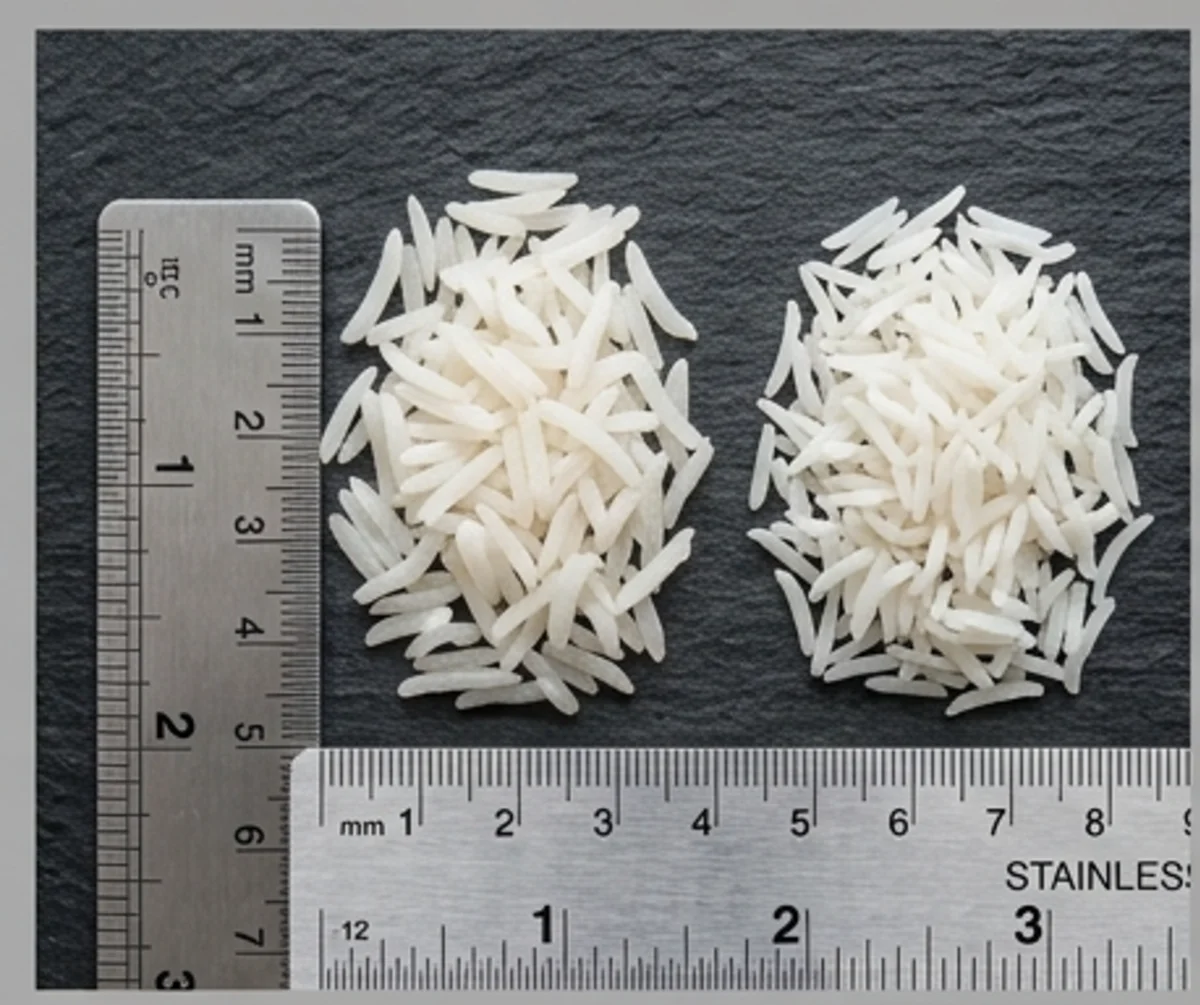
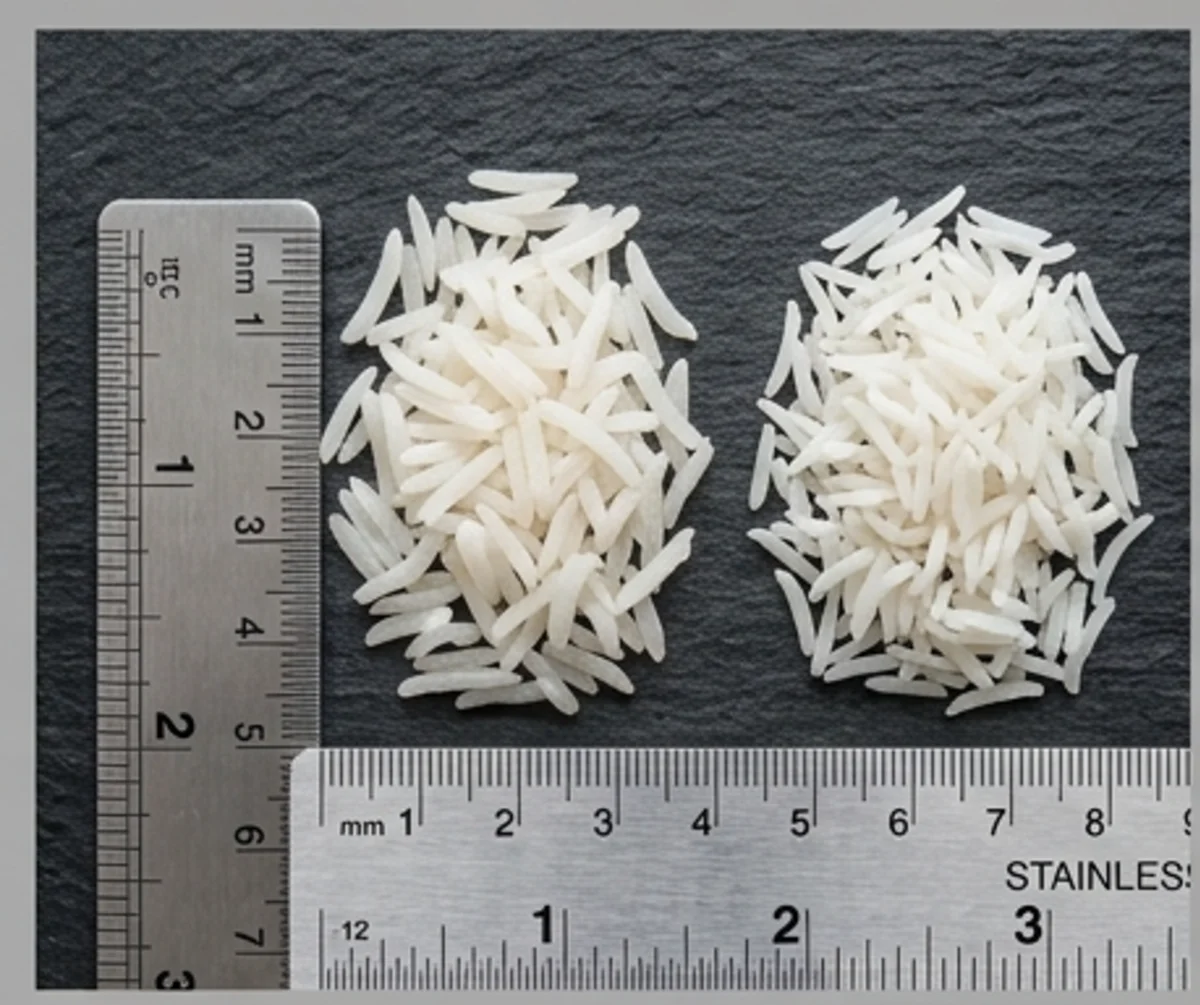 Figure 1: Measuring uncooked raw length (8.4mm) against cooked expansion (22mm) under calibrated optical micrometer.
The Chef’s Dilemma: Raw Price vs. Cooked Plate Yield
Many institutional buyers make the costly mistake of evaluating rice solely on a per-metric-tonne purchase cost. However, in large-scale commercial kitchens serving 5,000 to 20,000 covers daily, the true profitability metric is cooked plate yield.
- 1121 Basmati: Expands dramatically lengthwise while maintaining slender girth, delivering approximately 4.0x to 4.2x raw-to-cooked weight volume. A single 25 kg bag yields roughly 100 kg to 105 kg of finished biryani rice.
- 1509 Basmati: Matures 25 days faster and yields slightly wider grains upon hydration, expanding roughly 3.7x to 3.9x. A 25 kg bag produces approximately 92 kg to 97 kg of cooked rice.
The Financial Reality: For à la carte dining and premium hotel operations, 1121’s exceptional visual plate volume easily justifies its market premium. For institutional catering operations operating on strict per-meal cost targets, 1509 Steam delivers an identical sensory presentation while reducing raw grain procurement expenditure significantly.
3. The New Crop “Moisture Trap”: Protecting Against Spoilage in Transit
The most dangerous operational hazard of the Q4 harvest is the “New Crop Moisture Trap.” Freshly harvested paddy arrives at northern Indian mandis with moisture contents frequently between 15% and 18%.
When accelerated export demand leads millers to rush drying cycles, raw and steamed rice is often bagged with moisture exceeding 13.5%.
Fresh Harvest Paddy (16% Moisture)
│
├── Accelerated / Incomplete Drying (< 48 hrs)
│ ▼
│ Packed into 20ft Dry Sea Container at 14% Moisture
│ ▼
│ Transit through Arabian Sea (35°C+ ambient, 85% humidity)
│ ▼
│ Thermal Inversion & Container "Sweat" (Condensation on ceiling)
│ ▼
│ RESULT: Yellowing, Kernel Caking, and Mycotoxin Rejection at Port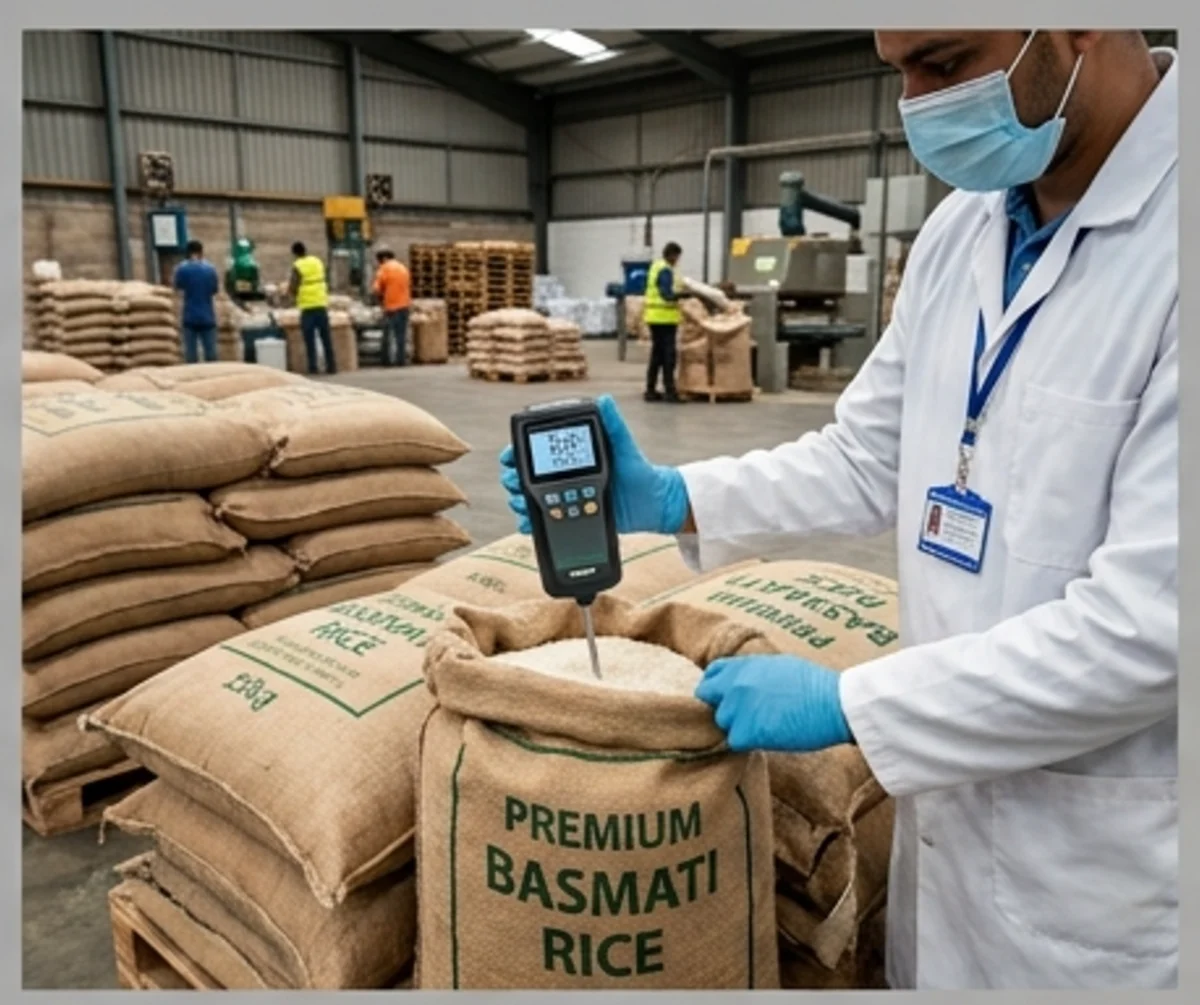 Figure 2: Digital resistance probe verifying that bulk grain moisture stays strictly below 12.0% prior to container sealing.
GCC Gulf Technical Regulation (GSO) Moisture Mandate
Under GSO 205/2014 (Rice Specifications) and SFDA Technical Regulations, the maximum permissible moisture limit for imported milled and parboiled rice is:
$$\text{Maximum Moisture} \le 13.0% \text{ by weight}$$
However, smart GCC buyers specify a contractual limit of 12.0% maximum on all Q4 consignments. In a sealed 20-foot shipping container carrying 26 metric tonnes of rice across the Arabian Sea, a 1.5% excess moisture differential translates to nearly 400 liters of free water evaporating and condensing onto top bag layers, producing rapid mold infestation and mandatory destruction notices from municipality inspectors.
4. Pre-Shipment Quality Protocol: The 5-Point Receiving Checklist
Before authorizing the release of payments under Letters of Credit (LC) or CAD (Cash Against Documents) terms, the QA team must cross-examine the third-party pre-shipment inspection certificate (SGS, Cotecna, or Intertek) against the following non-negotiable parameters:
1. Purity and Non-Basmati Admixture
Commercial adulteration often involves blending genuine 1121 with cheaper non-basmati varieties (such as PR-106 or Sharbati). Demand a DNA PCR Purity Certificate certifying at least 95% genetic varietal purity.
2. Moisture Content at Wharf
Must be measured via a calibrated digital moisture meter (capacitance or dielectric method) immediately before container stuffing, with an absolute ceiling of 12.5% (target 11.8% to 12.2%).
3. Broken Kernels & Chalkiness
- Extra Well-Milled 1121: Maximum 1.0% broken (kernels less than 3/4 length of average whole grain).
- Chalky Kernels: Maximum 1.5% for steam varieties; strictly 0% for parboiled/sella grades.
4. Live Infestation (Weevils & Larvae)
Certificate must confirm zero live or dead insects with mandatory phosphine ($PH_3$) fumigation dosage of at least 3 grams per cubic meter held for a minimum of 72 to 120 hours under gas-tight tarpaulins.
5. Packaging Integrity
For retail and foodservice supply, 20 kg, 25 kg, and 40 kg woven polypropylene (PP) or non-woven breathable bags must include inner micro-perforated liners to allow atmospheric stabilization without moisture ingress.
5. Strategic FAQs for Importers and Procurement Officers
What is the difference between Steam Basmati and Parboiled (Sella) Basmati?
Steam Basmati is produced by passing pressurized steam through raw paddy before de-husking and milling. This drives surface nutrients into the endosperm and hardens the grain, preventing breakage while preserving the white, pearlescent color and sweet aroma prized in Arabic and South Asian cuisine. Parboiled (Sella) Basmati undergoes a complete warm-water soaking, steaming, and gelatinization process. This produces a yellowish, exceptionally hard grain that cannot be overcooked or mashed, making it the standard choice for mass institutional catering and buffet warmers.
Are export permits (RCAC) still required for Basmati from India?
Yes. Although the Minimum Export Price (MEP) floor was abolished, all Basmati export contracts must still be formally registered with APEDA (Agricultural and Processed Food Products Export Development Authority) to obtain a Registration-Cum-Allocation Certificate (RCAC) before customs clearance at Indian exit ports.
Can 1509 Basmati be labeled simply as “Basmati Rice” in the GCC?
Yes. Pusa Basmati 1509 is an officially notified variety under the Indian Seeds Act and recognized under GCC food labeling standards as genuine Basmati rice, provided varietal purity and standard grain specifications meet the Gulf Standard GSO 205 requirements.
How does shipping transit time affect new-crop Basmati grain performance?
Unlike fine wines, Basmati rice actually benefits from aging. Fresh new-crop rice cooked immediately after harvest can cook moist and gummy. The 10 to 14 days of maritime transit from Mundra/Nhava Sheva to Jebel Ali, followed by 30 days of dry warehouse holding in the GCC, allows enzymatic stabilization, resulting in noticeably superior grain separation upon boiling.
6. Secure Your Q4 Basmati Allocations with GB Trading
At Global Bridge Trading (GB Trading), we eliminate supply chain uncertainty by contracting directly with certified modern milling facilities across Punjab and Haryana. Every container dispatched to Jebel Ali, Dammam, and Jeddah undergoes rigorous dual-stage inspection:
- Laboratory DNA Authenticity: Certified 95%+ purity on all 1121, 1509, and 1401 consignments.
- Moisture-Guaranteed Sealing: Strictly $\le 12.0%$ moisture verified with pre-stuffing probe telemetry.
- Full Compliance Documentation: APEDA RCAC, Phytosanitary Certificates, Non-GMO declarations, and SABER / FASEH electronic conformity filings.
Looking to lock in stable Q4 pricing or request container-load samples?
- Explore our verified India to UAE Rice Import Route
- Review compliance guidelines for India to Saudi Arabia Shipments
- Read our related analysis on SABER PCoC Requirements for Basmati Rice
👉 Contact our Agricultural Desk on WhatsApp to receive current FOB/CIF quotations and mill specification sheets.