
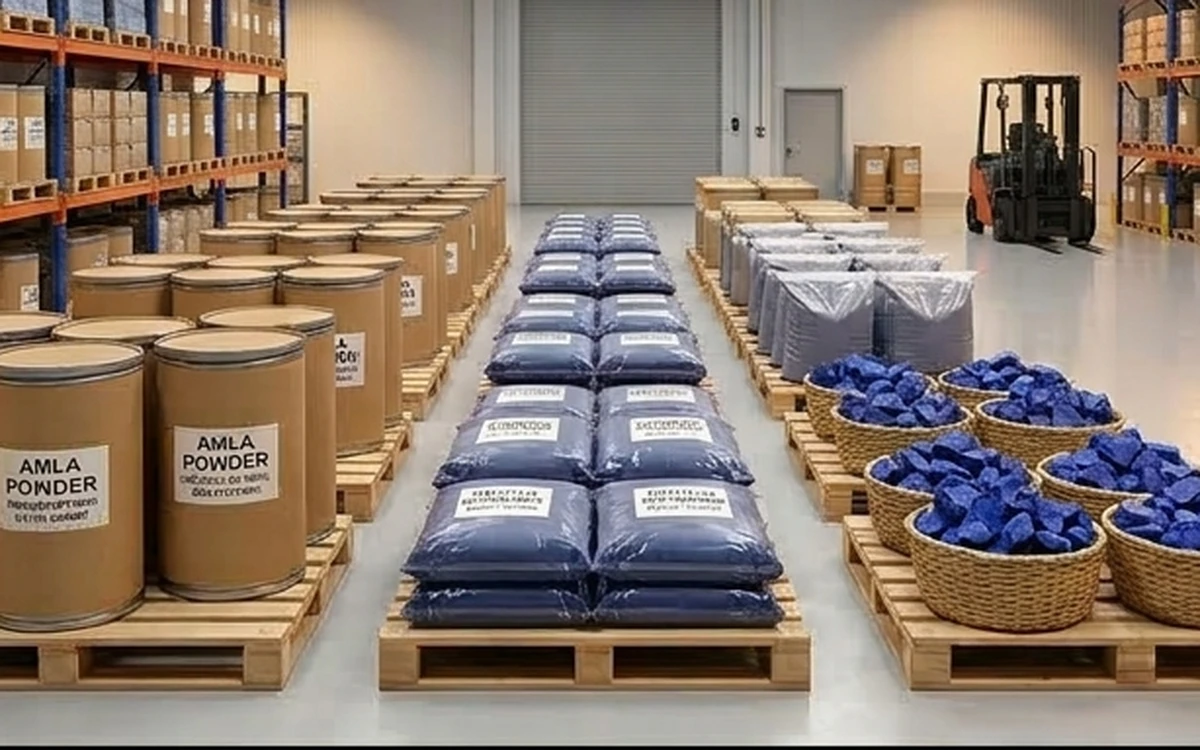
Sourcing Cosmetic Herbals: Bulk Amla, Organic Indigo, and Moroccan Blue Nila for Gulf Formulators
From microbiological limits and mesh-size sifting to heavy-metal ICP-MS assays and GSO 1943 compliance, here is how private labels and cosmetic manufacturers import premium botanical powders into the GCC.

Table of Contents
Bottom Line Up Front (BLUF): Surging consumer demand across the UAE and Saudi Arabia for clean-label haircare, herbal hair dyes, and traditional hammam skincare has turned botanical raw materials—specifically Indian Amla fruit powder (Phyllanthus emblica), Organic Indigo leaf powder (Indigofera tinctoria), and authentic Moroccan Blue Nila stone/powder (Indigofera suffruticosa / Nila Zarka)—into high-volume import commodities. However, commercial consignments regularly face customs rejections or private-label recall risks due to three failure points: (1) heavy-metal contamination (lead, arsenic, mercury) exceeding GSO 1943/2021 Safety Requirements of Cosmetics, (2) adulteration of Blue Nila with industrial textile dyes or synthetic copper-based pigments, and (3) coarse milling (below 80 mesh) causing suspension collapse in commercial formulations.
1. The Gulf Natural Cosmetics Boom: Why These Three Botanicals Dominate
The Middle East and North Africa (MENA) natural personal care sector is experiencing an unprecedented shift toward plant-based, clean-label raw materials:
- Indian Amla Powder (Phyllanthus emblica): Revered in Ayurvedic medicine, Amla is the cornerstone of herbal hair oils, volumizing shampoos, and scalp-detox masks due to its natural ascorbic acid (Vitamin C), gallic acid, and ellagitannin profile.
- Organic Indigo Leaf Powder (Indigofera tinctoria): As regulatory scrutiny tightens on synthetic paraphenylenediamine (PPD) and ammonia in chemical hair dyes, commercial hair-color brands blend organic Indigo powder with pure Henna (Lawsonia inermis) to achieve natural brown, auburn, and jet-black shades.
- Moroccan Blue Nila (Nila Zarka): Historically used in Saharan bridal preparations and royal Moroccan bath rituals, natural Blue Nila is in immense demand for skin-brightening face masks, body scrubs, and whitening soaps across salons and boutique cosmetic lines in Riyadh, Jeddah, and Dubai.
Raw Botanical Source (India / Morocco)
  │
  ├── Harvesting, Shade Drying, & Multi-Stage Pulverization (80–120 Mesh)
  │     ▼
  ├── Laboratory Screening (ICP-MS Heavy Metals + Microbial Bio-Burden)
  │     ▼
  ├── Vacuum Barrier Packaging & Palletization (Moisture Protection)
  │     ▼
  ├── GCC Regulatory Clearance (SFDA Cosmetic E-Portal / UAE Montaji)
  │     ▼
  └── RESULT: Certified Clean-Label Formulation Feedstock
2. Technical Specifications: Amla, Indigo, and Blue Nila
Formulating stable commercial emulsions, powders, and suspensions requires rigid incoming raw material standards:
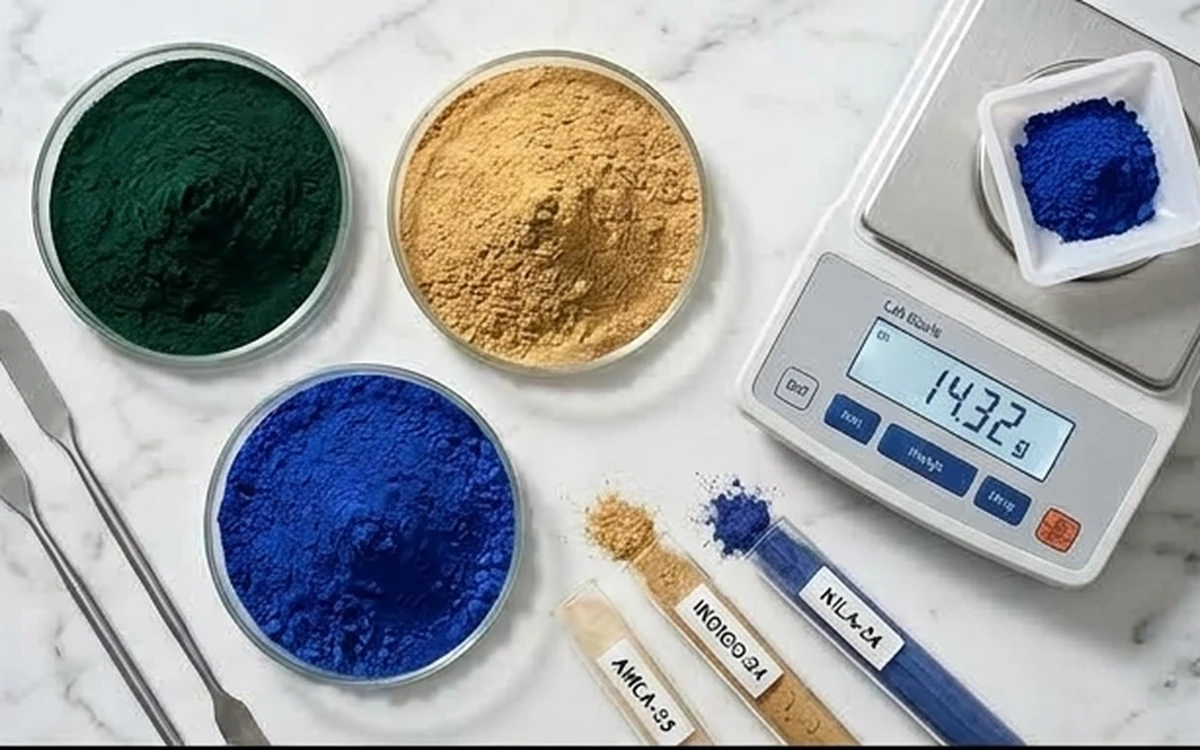 Figure 1: Quality evaluation of organic botanical powders: particle size validation via optical microscopy and heavy-metal screening.
| Botanical Ingredient | INCI Nomenclature | Botanical Part | Required Mesh Fineness | Active Marker / Assay | Primary GCC Formulation Use |
|---|---|---|---|---|---|
| Amla Fruit Powder | Phyllanthus Emblica Fruit Extract / Powder | Dried pericarp (seedless) | 80 – 100 Mesh | Total Tannins $\ge 25%$, Vitamin C $\ge 1.5%$ | Hair strengthening oils, scalp masks, skin serums |
| Indigo Leaf Powder | Indigofera Tinctoria Leaf Powder | Matured green foliage | 100 – 120 Mesh | Indigotin content $\ge 0.5%$, Moisture $\le 8%$ | 100% plant-based hair dyes, color-correcting shampoos |
| Moroccan Blue Nila | Indigofera Suffruticosa Powder | Mineralized plant extract | 120 – 150 Ultra-Fine | Natural blue pigment (Zero synthetic azo dyes) | Hammam scrubs, brightening clay masks, artisan soap |
The Milling Standard: Why 80+ Mesh is Mandatory
Industrial cosmetic manufacturing cannot utilize rough agricultural powders. If botanical powders are milled below 80 mesh:
- In hair masks and conditioners, coarse grit resists uniform water dispersion, clogs industrial filling nozzles, and creates a sandy, abrasive mouthfeel on consumer scalps.
- In pressed face powders or dry clay masks, coarse grains precipitate rapidly to the bottom of blending vats, causing uneven color streaks in finished retail jars.
- For Blue Nila, cosmetic grade requires 120 to 150 mesh micro-pulverization, ensuring the mineral-botanical matrix disperses instantly into Moroccan black soap (Savon Noir) or Kaolin clay without scratching epidermal layers.
3. Regulatory Compliance: GSO 1943/2021 & Heavy Metal Limits
In Saudi Arabia and the UAE, herbal cosmetic ingredients are not treated as basic agricultural crops. Under Gulf Standard GSO 1943/2021 (Cosmetic Products - Safety Requirements), raw botanicals must pass stringent analytical testing before port release:
1. Heavy Metal Maximum Tolerances (ICP-MS Testing)
Botanicals grown in mineral-rich soils or processed using uncalibrated steel blades frequently carry toxic trace elements. The SFDA and UAE MoIAT enforce strict limits:
- Lead ($Pb$): Maximum permissible limit is $< 10.0\text{ ppm}$ (parts per million).
- Arsenic ($As$): Maximum permissible limit is $< 3.0\text{ ppm}$.
- Cadmium ($Cd$): Maximum permissible limit is $< 3.0\text{ ppm}$.
- Mercury ($Hg$): Maximum permissible limit is $< 1.0\text{ ppm}$.
2. Microbiological Limits (GSO 1943/2021 Table 3)
Because herbal powders are organic plant matter, gamma-irradiation or controlled steam-sterilization is required to control bio-burden:
- Total Aerobic Microbial Count (TAMC): $\le 1 \times 10^3\text{ CFU/g}$ for products applied around the eye or mucous membranes; $\le 1 \times 10^4\text{ CFU/g}$ for rinse-off hair products.
- Total Combined Yeast and Mold Count (TYMC): $\le 1 \times 10^2\text{ CFU/g}$.
- Specified Pathogens: Zero tolerance (complete absence) for Pseudomonas aeruginosa, Staphylococcus aureus, and Candida albicans in a 1g sample.
4. The Blue Nila Adulteration Trap: Spotting Synthetic Fakes
Due to the limited harvest yield of genuine Moroccan Blue Nila stone and the high wholesale price of pure Saharan extract, the Middle Eastern market is flooded with synthetic counterfeits:
GENUINE MOROCCAN BLUE NILA          vs.     COUNTERFEIT SYNTHETIC DYE
─────────────────────────────────────────────────────────────────────────────
• Origin: Natural plant pigment             • Origin: Industrial textile dye / copper salts
• Color: Deep royal blue with indigo tint   • Color: Neon electric blue / harsh chemical blue
• Dispersion: Soft botanical suspension     • Staining: Permanent chemical skin dye
• pH Reaction: Neutral botanical matrix     • Toxicity: Fails GSO 1943 heavy metal limits
• Cost: Premium authentic artisanal import  • Cost: Cheap chemical powder blend
The Water Dissolution & Spectrophotometry Test
Commercial cosmetic labs test incoming Blue Nila lots using solvent dispersion:
- Sedimentation Assay: Pure Blue Nila slowly settles at the base of a graduated cylinder with a soft violet-blue tint in the water column. Synthetic methylene blue or chemical pigments instantly dissolve into an artificial, stain-forming fluorescent blue liquid that permanently discolors skin and ceramic tile.
- Thin Layer Chromatography (TLC): Confirms the organic presence of indigotin and indirubin while ruling out CI 42090 (Brilliant Blue FCF) or industrial textile colorants.
5. Export Packaging & Shelf-Life Stabilization
Bulk botanicals are highly hygroscopic; exposure to tropical ambient humidity during sea transit triggers oxidation, mold growth, and active compound degradation:
- Inner Barrier Lining: 25 kg multi-wall virgin kraft paper bags fitted with an airtight 100-micron food-grade polyethylene heat-sealed liner.
- Vacuum Packaging for Indigo: Pure Indigo powder oxidizes when exposed to ambient air, converting active dye precursor into inert material. Export cartons must be packed under vacuum or nitrogen flush.
- Moisture Desiccant Packs: Inclusion of 100g clay desiccant packs in every master shipper drum, maintaining relative humidity inside shipping containers below 60%.
- Palletization: Stretch-wrapped on fumigated ISPM-15 heat-treated wooden or heavy-duty plastic pallets to prevent moisture capillary uptake from container floorboards.
6. Strategic FAQs for Cosmetic Procurement Managers
Do bulk herbal cosmetic powders require registration on SFDA e-Cosmetics?
Yes. If the herbal powder is imported as a finished consumer retail item (e.g., packaged in 100g or 250g retail pouches for consumer use), it must be registered on the SFDA Electronic Cosmetic Products Notification System (e-Cosmetics) and carry mandatory Arabic labeling and batch coding. If imported in bulk (25kg drums) as an active raw material for a licensed local factory, it requires a Certificate of Analysis (CoA) and Material Safety Data Sheet (MSDS) cleared through the customs industrial chemical pathway.
What is the typical shelf life of organic Amla and Indigo powders?
When stored in sealed, light-proof containers at temperatures below $25^\circ\text{C}$ and relative humidity under $60%$, both Amla and Indigo powders maintain their potency and microbial stability for 24 months from the date of pulverization.
Can Moroccan Blue Nila be shipped directly in rock/stone form?
Yes. Many boutique spa chains and traditional hammam brands prefer importing raw Blue Nila rock pieces to prove authenticity to high-net-worth salon clientele. Global Bridge Trading supplies both authentic whole Saharan Nila stone chunks and pre-sifted 120-mesh cosmetic-grade powder.
7. Secure Certified Cosmetic Herbals with GB Trading
At Global Bridge Trading, we bridge the gap between traditional botanical origins and modern GCC cosmetic compliance:
-
Verified Origins: Direct sourcing partnerships with certified organic farms in Rajasthan (India) and traditional artisanal cooperatives in the Atlas and Saharan regions of Morocco.
-
Batch Testing: Every container consignment is accompanied by independent third-party laboratory CoAs certifying ICP-MS heavy-metal safety and zero synthetic dye adulteration.
-
Consistent Mesh Grading: Guaranteed 80 to 120 mesh particle size consistency tailored for industrial emulsions, soaps, and hair formulations.
-
Explore our verified India to UAE Botanical Trade Routes
-
Review our quality guide on Bulk Himalayan Shilajit Resin Standards
-
Learn about Detecting Raw Commodity Adulteration
👉 Contact our Cosmetic & Botanical Ingredients Desk on WhatsApp to request technical specification sheets, heavy-metal CoAs, and commercial FCL/LCL sample kits.